
By Moira Wilson
Micro-needling is a safe, simple and effective dermal technique used in the treatment of various scars and anti-ageing concerns. It stimulates the skin’s natural ability to repair the visible effects of ageing, as well as skin damaged by scarring or donor sites in burns. It is a controlled skin injury without injuring the epidermis.
The goal of micro-needling is the percutaneous induction of collagen by creating a controlled reset or “reboot” at cellular level. The treatment stimulates a wound-healing cascade, encouraging the release of growth factors and supporting the natural repair process within the skin.
Micro-needling works through the creation of thousands of controlled micro-injuries in the skin. These tiny channels trigger the body’s natural wound-healing response, resulting in collagen formation, tissue re-modelling and improved support of the underlying skin structure. The channels usually close within a few hours after induction.
There is important communication, or “cross-talk”, between the epidermis, dermis and the dermal-epidermal junction. Micro-needling can therefore have an effect across these three different layers of the skin. The process assists in re-organising old collagen fibres and can significantly increase the production of collagen and elastin. Histological analysis after several micro-needling sessions has demonstrated reports of increased collagen and elastin production.
Micro-needling also breaks down old collagen strands in the superior layer of the dermis. Medical dermal needling has been used for scars since as far back as 1995, with work by Orentrich et al, followed by publications from Fernandes et al and Aust et al.
Micro-needling Devices
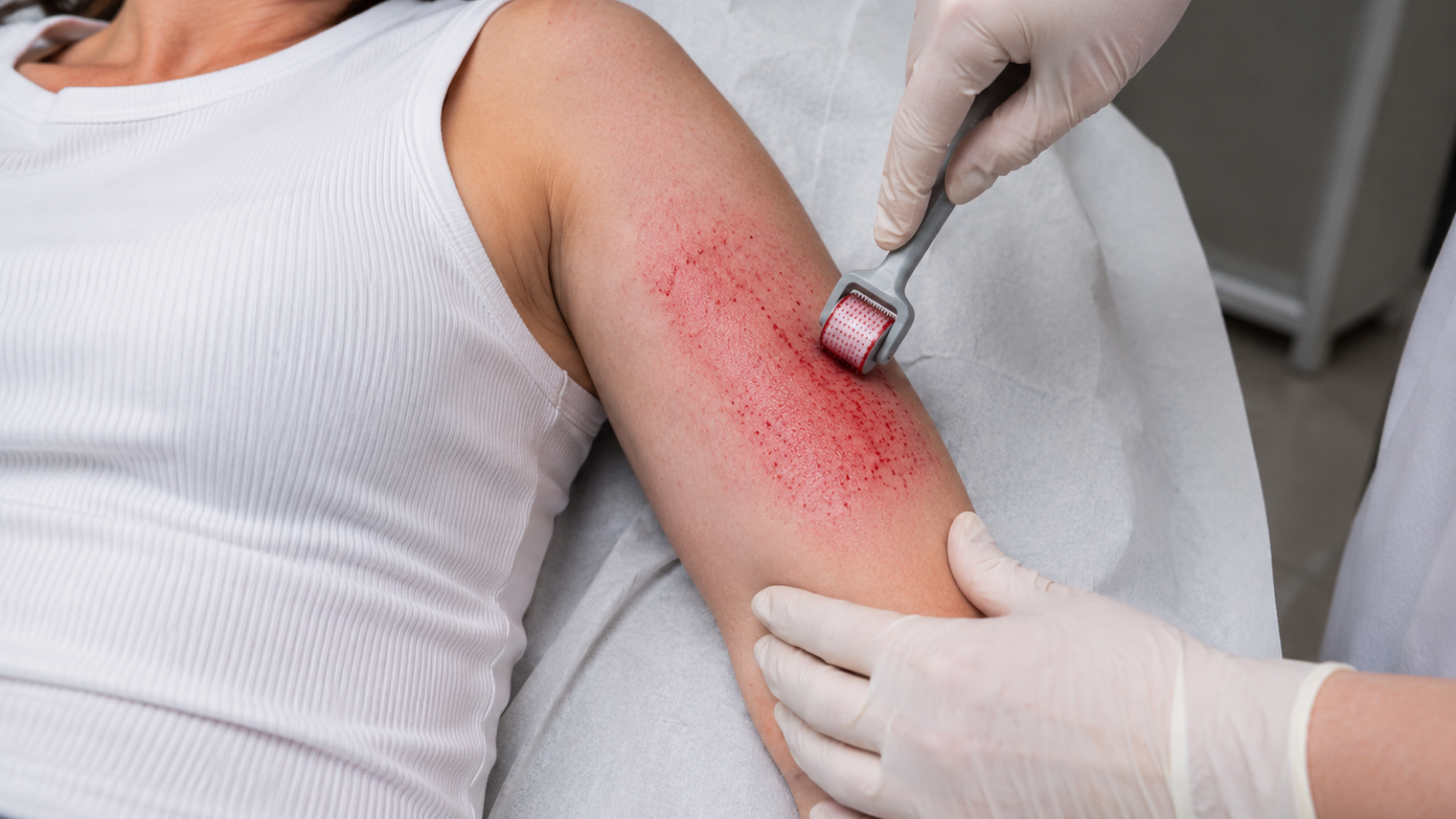
Micro-needling involves pricking the skin many times down to the level of the dermis. Various devices are used for medical needling, including dermarollers, dermapens and dermastamps.
A dermaroller is a drum-shaped roller containing approximately 192 needles. The diameter of these needles may range from 0.07 mm to 0.2 mm, with needle lengths ranging from 0.2 mm to 3 mm depending on the required depth of treatment. Needles are usually made from stainless steel or titanium and are used as a single-use item per patient.
The treatment area may be rolled approximately 15 times, creating around 250 holes per square centimetre. A dermaroller is generally useful for larger areas, while a dermapen may be more suitable for smaller or more delicate areas.
Electronic dermal pens are popular and easy to use, particularly for areas such as nasolabial folds or finger webs. The needle speed can be adjusted, and higher speeds may reduce discomfort. A dermapen also allows for multiple needle depths to be selected, while a dermaroller has a fixed depth.
Effects on the Skin
When keratinocytes function optimally, the epidermis becomes thicker. Keratinocytes release KDAF and KD-CFF, which help suppress the inflammatory process.
In hypertrophic scarring, the epidermis is often thinner than in normal tissue. Micro-needling has demonstrated histological improvement in epidermal thickness, supporting a healthier skin structure.
Melanocytes work in synergy with keratinocytes. When keratinocyte function is reduced, inflammation may increase. Micro-needling can help restore keratinocyte function and normalise communication with melanocytes. This may be useful in the repigmentation of hypopigmented scars.
Uses of Micro-needling
Micro-needling may be used for cosmetic and medical purposes. Cosmetically, it is commonly used for skin rejuvenation and anti-ageing. Medically, it may be used in the treatment of hypertrophic scarring, donor sites, surgical scars, varicella scars, vitiligo, acne scars, melasma and stretch marks.
For rejuvenation purposes, three to six treatments are often recommended. For pigmentation concerns, four to six treatments may be advised. Results may be visible after the first treatment, but longer-lasting and more significant improvement is usually seen after three to six sessions.
The skin may continue to improve over a period of six to twelve months as new collagen forms and remodels.
Micro-needling as a Drug Delivery System
Micro-needling can also be used as a drug delivery system. Because the needles penetrate into the dermis, certain active substances can be delivered more effectively into the skin.
One example is the use of micro-needling with minoxidil in cases of hair loss. Medical needling combined with drug delivery has shown promising results in hair restoration. Treatment is often carried out approximately every six weeks for around six sessions, with needle lengths commonly ranging from 0.5 mm to 1.5 mm.
Needle Length and Treatment Depth
Needle length is important and depends on the treatment goal and the condition being treated.
For acne scars and surgical scars, needle lengths of approximately 0.5 mm to 1.5 mm may be used. For hypertrophic scars, depths of 1 mm to 3 mm may be required. For striae, needle lengths of 2.5 mm to 3 mm may be used.
Needle lengths of 0.75 mm to 3 mm may lead to bleeding and stimulate the inflammatory healing process. Micro-needling also allows serum delivery into the dermis, where it may have an optimal effect.
A needle length of 0.75 mm is often considered the borderline between cosmetic and medical needling.
Unlike laser treatments, which are ablative in nature, micro-needling works by stimulating the skin and encouraging the epidermis to become thicker.
Advantages of Micro-needling
Micro-needling is a relatively short procedure with mild post-procedural effects. The skin may appear similar to mild sunburn after treatment, but there is usually little or no downtime.
Typically, three to six treatments are performed at intervals of around six weeks. Micro-needling is suitable for a wide range of skin types, from light to dark skin.
Other treatment modalities may also be used alongside micro-needling where clinically appropriate. Single-use kits support hygiene and help prevent cross-contamination.
Micro-needling can be used on the face, neck and décolletage for anti-ageing purposes, and on various areas of the body for scarring.
Before Treatment
Pre-treatment preparation should take place before micro-needling. A local numbing agent may be applied around 30 to 60 minutes before the procedure to reduce discomfort and make the treatment almost painless.
For anti-ageing purposes, vitamin A and vitamin C may be taken orally for approximately two weeks before treatment. A vitamin A 0.5% to 1% skin solution may also be used topically for a few days before needling, where appropriate and under professional guidance.
Consent for before-and-after photography is worthwhile, especially when tracking progress over a series of treatments.
After Treatment
After the procedure, the treated skin may look like moderate sunburn. This usually improves within 24 to 48 hours. The epidermis heals rapidly, often within a matter of hours.
There may be some visible improvement within a few days, but maximum results usually take around six weeks to become evident as new collagen forms. Improvement may continue over several months.
After treatment, the skin should be kept moist. There should be no crusting of the skin. Direct sunlight should be avoided, and bandages should not be used unless specifically advised by the treating practitioner.
Make-up can usually be worn the following day, depending on the skin’s response and the practitioner’s aftercare instructions.
Itchiness is common for a few days after treatment due to increased trans-epidermal water loss from the puncture wounds. This generally settles fairly quickly.
Contraindications
Micro-needling is not suitable for every patient. Contraindications may include skin cancer, solar keratoses, active skin infection, uncontrolled coagulation status and chemotherapy.
Keloid scarring is also a contraindication, as every pinprick may potentially become a keloid.
Patient consent is vital, and the patient must be competent to provide informed consent before treatment.
Conclusion
Micro-needling is a versatile dermal tool within the practitioner’s treatment options. It can be used for both cosmetic and medical indications and has demonstrated significant potential in skin rejuvenation, scar management and tissue re-modelling.
When performed correctly and with appropriate patient selection, micro-needling offers meaningful results with little downtime and relatively mild post-treatment effects.
Download PDF copy:
“`